

WISP Requirements for Accounting Firms
- Most accounting and tax firms need a WISP: the FTC Safeguards Rule requires a written information security program, and every PTIN renewal asks you to confirm you have one.
- IRS Publication 4557 sets six core expectations, from naming a qualified individual to planning your incident response.
- The FTC Safeguards Rule adds specifics such as multifactor authentication, encryption, an annual report to leadership, and a 30-day breach notice to the FTC.
- A complete WISP covers 12 components, and a yearly review keeps it accurate as your people, tools, and vendors change.
- Start from a template, then customize it to match how your firm actually works.
A WISP (Written Information Security Plan) is a document that explains how your firm identifies, assesses, and manages cybersecurity risks to protect sensitive client information. For accounting firms and tax preparers, WISP requirements come from two places: the FTC Safeguards Rule, which requires most firms to keep a written information security program, and the IRS, which asks every preparer to confirm they have a WISP at PTIN renewal. This guide covers what those requirements are, what your plan must include, and how to keep it current.
What Is a WISP?
Your WISP is the roadmap for how your firm handles data security. It answers four questions: who is responsible for data security, what safeguards protect client data, how employees are trained, and what happens if there is a cyber incident. A well-built WISP shows clients, regulators, and insurers that your firm takes data protection seriously.
How WISP requirements developed
- 1996: The Health Insurance Portability and Accountability Act (HIPAA) set an early standard for formal information security programs.
- 1999: The Gramm-Leach-Bliley Act (GLBA) required financial institutions, including many accounting firms, to protect consumer financial data.
- 2003: The FTC’s Safeguards Rule took effect, requiring covered institutions to maintain a written information security program.
- 2000s and 2010s: States added their own data security and breach notification laws.
- 2021: The FTC updated the Safeguards Rule with more specific requirements, such as multifactor authentication and encryption.
- 2023: The IRS began asking tax preparers to confirm they have a WISP as part of annual PTIN renewal.
- 2024: The Safeguards Rule’s breach notification requirement took effect.
IRS WISP Requirements for Tax Preparers
The IRS expects tax professionals who handle taxpayer data to maintain a written security plan. When you renew your PTIN on IRS Form W-12, Question 11 asks you to confirm that you have a WISP. The form is signed under penalties of perjury, so answering yes without a plan in place puts your PTIN at risk and can expose you to penalties.
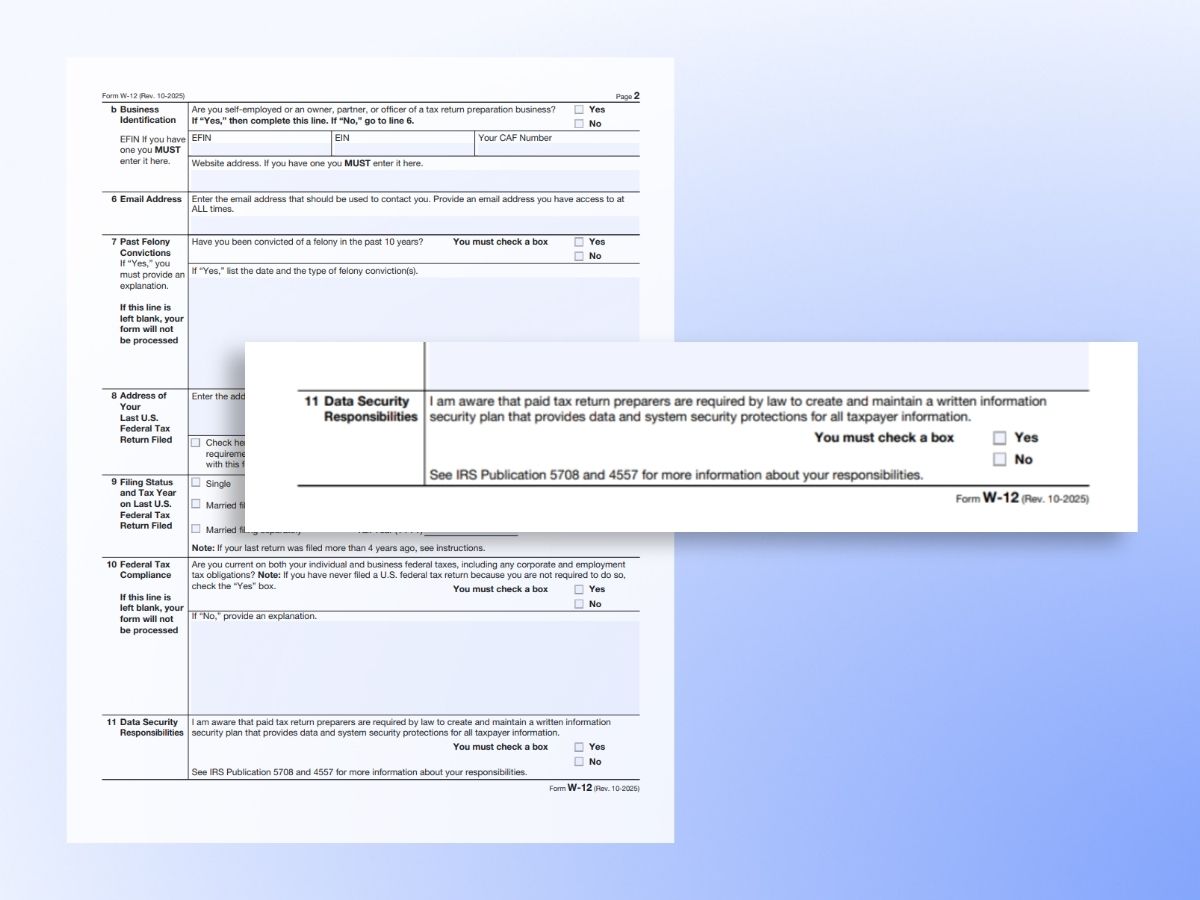
To understand what the plan should contain, start with IRS Publication 4557.
IRS Publication 4557: 6 core requirements
IRS Publication 4557, “Safeguarding Taxpayer Data,” is the clearest roadmap for tax preparers. Our IRS Publication 4557 guide covers it in detail. Here are its six core expectations:
- Designate a qualified individual. Assign one person to oversee your security program: assessing risks, implementing controls, and managing compliance. In small firms, this is often the owner.
- Conduct a risk assessment. Document the client data you collect and where it could be compromised, including internal risks (employee error, unauthorized access), external risks (phishing, malware), and environmental risks (device theft). Update it regularly.
- Design and implement safeguards. Put technical controls (firewalls, encryption, multifactor authentication), physical controls (locked cabinets, screen locks), and administrative controls (access policies, termination procedures) in place, and document them in your WISP.
- Oversee service providers. Confirm that vendors who access, store, or transmit taxpayer data maintain appropriate security, and include data protection requirements in their contracts.
- Plan your incident response. Document who is notified, how incidents are contained, and how clients are informed. The IRS also asks you to report breaches involving taxpayer data to your IRS Stakeholder Liaison.
- Evaluate and adjust the program. Review your plan at least annually and whenever your firm changes, such as new employees, new technology including AI tools, new client types, or after a security incident. If your firm uses AI, an AI policy template for accounting firms gives you a starting point.
For the six baseline technical protections the IRS recommends alongside your plan, see the IRS Security Six.
What the FTC Safeguards Rule Adds
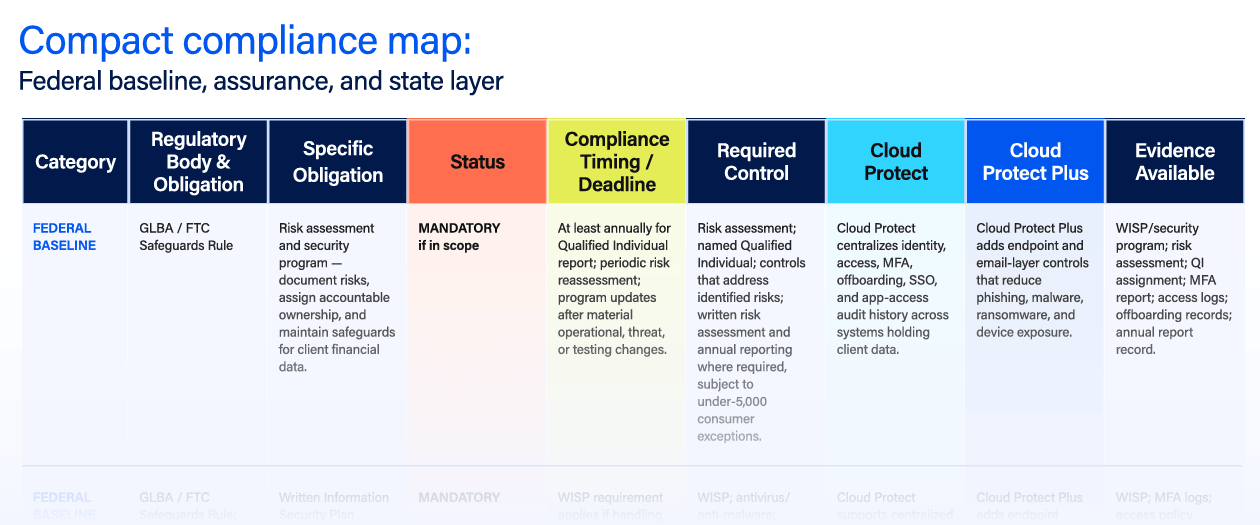
Accounting firms that provide tax preparation, financial planning, or advisory services generally qualify as financial institutions under the Gramm-Leach-Bliley Act, which puts them under the FTC Safeguards Rule. The rule overlaps heavily with Publication 4557 and adds more specific requirements:
- Multifactor authentication for anyone accessing customer information
- Encryption of customer information at rest and in transit
- Regular monitoring and testing of your safeguards
- Secure disposal of customer information you no longer need
- Written contracts that require service providers to protect data
- A written incident response plan
- A written report to your owners or senior leadership at least once a year on the status of the program
Since May 2024, firms must also notify the FTC within 30 days of discovering a breach involving unencrypted information of 500 or more customers. One well-designed WISP can satisfy both the IRS and the FTC. Where the two differ, the FTC’s requirements are usually more detailed. For the full list, use our FTC Safeguards Rule checklist.
Why a WISP Matters Beyond Compliance
A WISP does more than check a regulatory box. When a breach happens, your team already knows who does what, which limits damage and shortens recovery. It gives you a framework for evaluating every vendor that touches client data, and it shows clients how you protect the sensitive financial information they trust you with. (Here’s more on how compliance builds client trust.) A plan only protects you when it shapes daily work, which is why secure accounting workflows matter as much as the document itself. Our webinar Beyond Compliance: A Well-Executed WISP covers what separates a filed plan from one that works. It also matters for insurance. Cyber insurers ask about your written security policies, and gaps between what you attest and what you actually do can complicate a claim. Learn more about cyber insurance for accounting firms.
WISP Checklist: 12 Components Every Plan Needs
A complete WISP includes:
1. Program objective and scope
Why the plan exists, and which client data and systems it covers. Cite IRS Publication 4557, the FTC Safeguards Rule, and any applicable state laws.
2. Designated responsible individuals
Name the qualified individual who oversees the program (often called the Data Security Coordinator) and a Public Information Officer who handles breach communications. Document each person’s responsibilities and their backup.
3. Written risk assessment
Document every type of client data you handle and the internal, external, and environmental threats to it. Assign each risk a level and schedule your next assessment. A firm security assessment shows which areas to examine.
4. Hardware and software inventory
List every device and platform that stores or processes client data, including cloud services, with its type, location, and the data it holds. Update the inventory whenever anything changes.
5. Access controls
Explain who can access client data and how. Turn on multifactor authentication for every system, give staff only the access their role requires, and document how access is granted and revoked.
6. Data encryption
Describe how you protect data at rest and in transit. Encrypt stored data, use TLS for data you send, and name the person responsible for managing encryption keys.
7. Secure data disposal
Set retention periods for client data and describe how you permanently destroy data you no longer need. Keep a log of what was destroyed and when.
8. Employee training program
Train every employee at hire and at least once a year on phishing, passwords, and incident reporting. Record completion dates per person.
9. Vendor oversight
Explain how you vet third parties that access client data. Request SOC 2 reports, include data protection language in contracts, and reassess key vendors every year.
10. Incident response plan
Document how your firm contains a breach, who must be notified, and what each staff member does. Keep a full data breach response plan and test it at least once a year.
11. Physical and remote work security
Cover office access, clean desk rules, and external devices. Address remote access, VPN use, screen locks, and laptop and mobile device policies.
12. Implementation and compliance statement
Confirm that the plan is in effect and aligns with IRS Publication 4557, the FTC Safeguards Rule, IRS Section 7216 (also known as IRC Section 7216) and applicable state laws. Include signature and date lines.
Download the WISP requirements checklist
Download the WISP requirements checklist, a one-page printable version of these 12 components plus the annual review questions below.
Annual WISP Review Checklist
Your WISP is a living document. Review it at least once a year and whenever a significant change affects your data environment. Put the review on the firm calendar instead of waiting for PTIN renewal at the end of the year, then run a quick self-check with the compliance readiness checklist to ensure you’re covered.
Here’s a brief overview of what each area of your WISP review should cover. For a full walkthrough, download our WISP requirements checklist.
Risk assessment
- Have you added new data types or client categories?
- Have new cyberthreats emerged since the last assessment?
- Did you have any security incidents or near-misses this year?
- Have previously identified risks been adequately mitigated?
Hardware and software inventory
- Have you added, retired, lost, or replaced any devices?
- Have you added new software platforms or cloud services?
- Are all inventoried devices still covered by your documented controls?
Access controls
- Is every active account tied to a current employee?
- Was access revoked promptly for everyone who left?
- Do access privileges still match each person’s role?
- Is multifactor authentication on for every required system?
Employee training
- Has every employee completed this year’s Security Awareness Training?
- Did new hires complete training within their first 30 days?
- Does the training reflect current threats and firm policies?
Incident response
- Have you tested the plan with a tabletop exercise or drill?
- Are contact lists and notification steps current?
- Does each staff member know their role in a breach?
Vendors
- Have you requested updated security documentation from key vendors?
- Have any vendors had a breach or changed their security posture?
- Do all vendor contracts include current data protection language?
- Do any new vendors need an assessment?
Regulations
- Has IRS Publication 4557 guidance changed?
- Have any FTC Safeguards Rule amendments taken effect?
- Have the state rules that apply to your firm changed?
- Is your WISP dated and signed for this review cycle?

3 WISP Best Practices
Every firm’s WISP will look different, depending on your size, the sensitivity of the data you handle, and the regulations that apply to you. These practices make the work more manageable for any firm.
Name your qualified individual first
Before you write anything, assign someone to own the WISP’s creation, maintenance, and costs. This person coordinates risk assessments, vendor reviews, and Security Awareness Training.
Start from a template
Writing a plan from scratch is slow and expensive. Begin with a trusted WISP template, then customize it to your firm’s people, systems, and procedures. The WISP workbook walks you through gathering the details you need to fill it in, from your data inventory to your vendor list.
Ask your technology providers for documentation
Cloud platforms often include encryption, multifactor authentication, access logging, and backups that your WISP can reference directly. Ask providers for SOC 2 reports or equivalent documentation, and confirm they understand accounting profession requirements and follow NIST or similar frameworks.
Get Help With Your WISP
The right WISP does more than satisfy a requirement. It shows you where your firm is vulnerable and gives you a plan for when threats become real. Start with our free WISP template and requirements checklist, or let our team build it with you through WISP for Firms. You can see what WISP for Firms includes and how to get started, or watch our webinar From Requirement to Readiness to see the process in action.
WISP Requirements FAQ
For most firms, yes. Accounting and tax firms that qualify as financial institutions under the Gramm-Leach-Bliley Act must keep a written information security program under the FTC Safeguards Rule. Separately, tax preparers confirm they have a WISP each year on IRS Form W-12 when they renew their PTIN, which is signed under penalties of perjury. Learn more in our guide to PTIN renewal WISP requirements.
IRS Publication 4557 is IRS guidance that explains how tax professionals should safeguard taxpayer data and what a security plan should cover. The FTC Safeguards Rule is a federal regulation under the Gramm-Leach-Bliley Act with specific, enforceable requirements, such as multifactor authentication, encryption, an annual report to leadership, and notifying the FTC of certain breaches. A single WISP can satisfy both. See our FTC Safeguards Rule checklist for the regulation’s full list.
Review your WISP at least once a year, and update it whenever something changes that affects how you protect client data, such as new staff, new software or AI tools, new vendors, or a security incident. The FTC Safeguards Rule also requires firms to regularly test and adjust their safeguards and report on the program to leadership each year. An annual review checklist makes the process repeatable.
Yes. A template built around IRS Publication 4557 and the FTC Safeguards Rule gives a small firm a complete structure to start from. The template only protects you once you customize it with your actual people, systems, vendors, and procedures, so avoid filing it unchanged. Rightworks offers a free WISP template for accounting firms and a step-by-step WISP workbook to help you complete it.
Firms can write a WISP in-house from a template, hire an IT or security consultant, or use a done-for-you service such as WISP for Firms from Rightworks. Costs range from staff time for the do-it-yourself route to a fixed or hourly fee for outside help. Our breakdown of what an IRS WISP costs compares the options.
