
The Data Behind Our Most Resilient Businesses
Most small business owners aren’t lying awake worrying about whether they have the latest software. They’re worried about making payroll, keeping the lights on, and staying ahead of whatever comes next. But new research shows that the businesses best positioned to weather those pressures—and pull ahead on revenue—share something in common: a deliberate approach to stability that most SMBs haven’t built yet.
The 2026 Business Stability Report from Rightworks surveyed 733 U.S. small and medium-sized businesses across the country to define what business stability actually looks like and to see where SMBs nationwide stand. The findings are equal parts eye-opening and encouraging. Most businesses have real room to grow, and the ones that have already done the work are seeing the payoff in a big way.
The best part? The same framework used to benchmark our respondents is now available to you. Get your Business Stability Scorecard in just 5 minutes.
Table of Contents
- Measuring Business Stability
- What Advanced-Stage Businesses Do Differently
- Industry Snapshots
- How Does Your Business Measure Up?
Measuring Business Stability
Business stability isn’t one-dimensional. It’s the product of many moving parts working together—how well a business uses technology, how prepared it is for threats, and how intentionally it plans for the future. To capture that complexity, the research was used to develop the Business Stability Scorecard, built on three pillars:
- Technology & Workflows: How well a business leverages cloud tools, AI, and digital infrastructure.
- Security & IT Administration: The depth of cybersecurity protections and how IT is managed.
- Business Management: Strategic planning, client strategy, and succession readiness.
Each business receives a score across all three pillars, placing them in one of five stages—from Stage 1: Establishing to Stage 5: Empowering. While 51% of SMBs surveyed landed in Stage 1, the average score sits at 49%—right on the doorstep of Stage 2. Most businesses are closer than they think to leveling up.
And the businesses that have already made that climb to top stages of stability? The data shows they’re not just more stable. They’re significantly more profitable.
Advanced-stage SMBs generate 38% more revenue per employee than their early-stage counterparts.
That’s not a small edge. That’s a structural advantage—and it doesn’t come from luck or a bigger budget. It comes from a set of deliberate choices around technology, security, and business planning that any business can make.
What Advanced-Stage Businesses Do Differently
So what’s actually driving that gap? The research draws a clear distinction between early- and advanced-stage businesses.
Here’s what we learned about advanced-stage businesses:
They are 3x more likely to use external IT support
Have significantly higher AI knowledge and comfort levels
Are 60% more confident in their security measures than Stage 1 businesses
Are significantly further along on cloud migration—79% hosting over half of their data and apps in the cloud compared to 56% of all respondents.
Zooming out, the numbers tell a consistent story.
Among all SMBs, critical planning practices are stuck in the low 40s:
- 43% have a strategic growth plan
- 44% have a documented data security plan
- 39% have a succession plan.
Among Stage 4 and 5 businesses? All three climb above 93%.
This shows the most stable businesses aren’t just working in their business. They’re working on it. Advanced-stage businesses are run with intention and have a solid plan for the future.
Industry Snapshots
The report breaks down stability scores across five industries—and while no sector has fully cracked the code, each one has a clear story to tell. Here’s a snapshot:
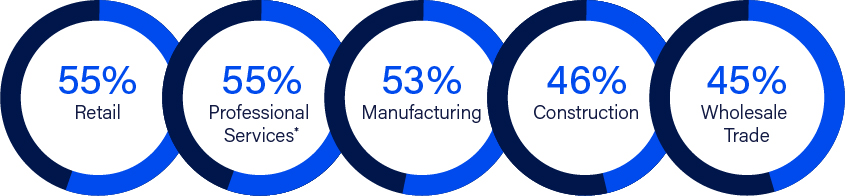
Retail: 55% Stability Score
Retail leads the pack on business management, earning a 63% score in that pillar—the highest of any industry. Retail SMBs are managing strategy and risk with notable confidence. [See the full retail breakdown →]
Professional Services: 55% Stability Score
Professional services businesses topped all industries in data security planning, with 56% having a documented plan in place—a reflection of the sector’s compliance culture. Technology and workflows still have room to grow. [Explore professional services data →]
Manufacturing: 53% Stability Score
Manufacturing scored the highest in Security & IT Administration at 65%—a sign the industry takes operational resilience seriously. It’s also the most likely sector to use outsourced or hybrid IT (65%). [Dig into manufacturing insights →]
Construction: 46% Stability Score
Construction SMBs show early-stage progress, but just 38% have a strategic growth plan—leaving substantial runway ahead. Security awareness is growing, and technology adoption is the clearest opportunity. [Get the full construction breakdown →]
Wholesale Trade: 45% Stability Score
Wholesale trade is making meaningful cloud strides—63% host over half their data and apps in the cloud—but with only 23% holding a data security plan, that investment isn’t backed by the strategy to fully protect it. [Gain wholesale trade insights →]
Across every industry, the story is less about who’s winning and more about how much runway remains. Stability scores cluster between 45% and 55%—a signal that most businesses, regardless of what they do or who they serve, are still in the early stages of building something that lasts. The question worth asking isn’t how your industry stacks up. It’s where your business stands within it.
How Does Your Business Measure Up?
Business stability isn’t built overnight, but it is built intentionally. The data from 733 SMBs nationwide makes one thing clear: the gap between struggling businesses and thriving ones isn’t about industry, size, or luck. It’s about whether leadership has made deliberate choices around technology, security, and planning. The businesses that have made those choices are generating more revenue meaningfully, operating with more confidence, and building something that lasts beyond any economic shift.
The most actionable thing this report offers isn’t a benchmark—it’s a mirror. The Business Stability Scorecard lets you see exactly where your business stands across all three pillars, which stage you’re in, and where the biggest opportunities lie. It only takes five minutes and gives you insights and strategies to move forward and build a business that’s truly built to last.

*Professional Services Total includes: Accounting/Tax/Bookkeeping, Finance/Insurance, Real Estate, Legal, IT Services, and other professional services.