AI Has Moved From a Future Possibility to a Present-day Reality
For tax professionals and business owners alike, the question is no longer whether AI will reshape tax services, but how quickly you can adapt to stay ahead of the curve.
Table of Contents
- Weighing the Risks and Rewards of an AI-focused Future
- How AI Is Impacting Tax Return Preparation
- Preparing for an AI-enhanced Future
- 4 Essential Skills for an AI-Powered Practice
- Implementing a Forward-looking Retraining Program
- Incorporate AI Technologies into Your Practice
Weighing the Risks and Rewards of an AI-focused Future
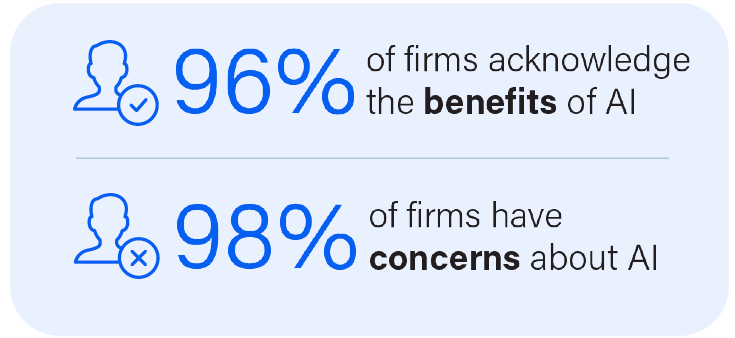
Almost all accounting firms (96%) agree that AI has real benefits for their work. At the same time, even more firms (98%) have worries about using AI. Weighing the pros of working faster and more accurately against the worries of keeping client data safe makes AI a tricky tool for firms to navigate. Add to that a steep learning curve, and it’s understandable why many firms are slow to adopt.
With so many firms caught between excitement and anxiety about AI, it’s clear that understanding this technology is no longer optional—it’s essential. Whether you’re a tax professional trying to stay competitive or a business owner wondering how AI might affect your tax preparation, knowing the basics of how AI is changing tax practices will help you make smarter decisions and ease those concerns. Let’s break down what’s really happening in the world of AI-powered tax services and what it means for you.
How AI Is Impacting Tax Return Preparation
Tax practices are being transformed by AI technologies that automate routine work, analyze complex data, and predict future tax scenarios, and the financial industry sees where this is headed.
Nearly two-thirds (64%) of finance leaders now rank AI and machine learning as a top investment priority in 2026 —up dramatically from 43% just a year earlier.
But what does this AI transformation actually look like in practice? Understanding the specific ways AI is being applied to tax preparation helps clarify both the opportunities and challenges firms face. From predicting tax liabilities to interpreting complex regulations, AI tools are tackling some of the most time-consuming and error-prone aspects of tax work. Here are the key areas where AI is making the biggest impact:
- Advanced predictive analytics. AI looks at past tax data to predict what you’ll owe in the future and suggests smart tax planning strategies to save money.
- Natural language processing (NLP). AI can now understand everyday language, which makes tax software easier to use and helps pull important information from documents automatically.
- Compliance and error detection. AI keeps up with constantly changing tax laws and spots mistakes or unusual items in tax returns before they become problems.
- Automated tax code interpretation. AI tools read and apply complicated tax rules on their own, reducing errors and saving tax professionals hours of research time.
Preparing for an AI-enhanced Future
The AI transformation is already underway. As the industry moves deeper into 2026, the need for firms to adapt and retrain their workforce has become critical. This retraining extends beyond technical skills to cultivating a culture of adaptability, strategic thinking, and continuous learning.
4 Essential Skills for an AI-Powered Practice
1. Understanding AI and Machine Learning
- Build foundational knowledge. Teach your team the essential concepts of AI and machine learning, including recent developments and how they’re impacting tax practices.
- Focus on practical applications. Show specific ways AI technology is being applied to tax return preparation and planning.
2. Data Literacy and Management
- Develop analytical skills. Train professionals to analyze and interpret the complex datasets that AI systems generate.
- Prioritize data security. Ensure everyone understands the critical importance of protecting client data privacy in an AI-driven environment.
3. Mastering AI Tools and Software
- Get hands-on experience. Provide practical training sessions with the AI-powered tax software and tools your firm will use.
- Commit to continuous learning. Build a culture where staying current with new technology is expected and supported.
4. Adapting to Evolving Roles
- Transition job functions. Help staff shift from traditional data entry tasks to more analytical, strategic, and advisory responsibilities.
- Strengthen client advisory skills. Train your team to effectively communicate AI-generated insights to clients and use them to deliver personalized tax planning recommendations.
Implementing a Forward-looking Retraining Program
So, now that you know what your team needs to learn, how do you accomplish it all? Implementing this program effectively will require a strategic approach. This should include:
- Diverse learning. Make use of a combination of online learning, workshops, and practical training sessions. Check out popular online learning platforms like LinkedIn Learning, Microsoft and Coursera, which offer a number of AI training resources geared toward every level of knowledge.
- Collaboration with AI experts. Wherever you find them, look to AI technology experts for specialized training and insights. Where would that be? For a start, conferences, your local community, even by listening to some of the many AI podcasts now available. Also, try to engage your accounting peers in regular discussions to understand what more progressive firms are doing.
- Ongoing training. AI technology is advancing rapidly, so one-time training isn’t enough. Schedule regular updates and refresher courses to keep your team current on new AI capabilities and changing tax regulations.
Incorporate AI Technologies into Your Practice
Firms that embrace this shift won’t just keep pace with AI innovations—they’ll dramatically enhance the efficiency and effectiveness of their tax practices, ultimately redefining their role in the rapidly evolving world of tax and accounting.