Protect Your Business from Cyberthreats
If you run or manage a small or mid-sized business, you’ve probably heard that cybersecurity is important. But between managing customers, employees, and operations, it can be hard to know where to start, or if you have enough protections in play right now.
The truth is, business security isn’t one single thing. It’s a set of overlapping protections that work together to keep your people, your data, and your systems safe. Think of it like a building: one strong wall doesn’t protect you if the roof has holes and the back door is unlocked.
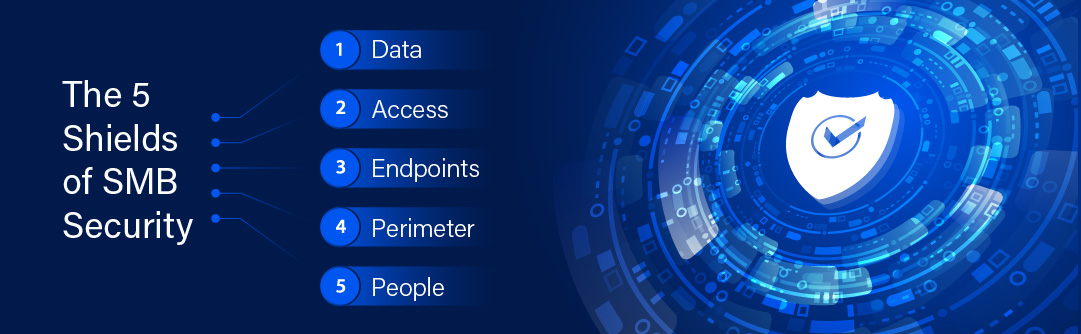
That’s where a layered framework comes in. Breaking security down into distinct categories makes it easier to understand what you’re protecting, why it matters, and whether any gaps exist. Here are the five core layers every small business should have covered.
Table of Contents
- 1. Protect Your Data
- 2. Protect Your Access
- 3. Protect Your Endpoints
- 4. Protect Your Perimeter
- 5. Protect Your People
- Why All Five Layers Matter
Let’s Get into the 5 Shields of SMB Security
1. Protect Your Data
Data is at the heart of almost every cyberthreat. Customer records, financial information, employee files, contracts, etc. If it lives on your systems, it has value to someone who shouldn’t have it.
Data protection covers three critical functions.
- Regular automated backups ensure your files and data are saved consistently, so if something goes wrong, whether it’s a ransomware attack, accidental deletion, or hardware failure, you can recover quickly without losing everything.
- Keeping your applications automatically updated is one of the simplest and most important defenses you have. Most cyberattacks exploit known vulnerabilities in outdated software, and automatic updates patch those gaps before attackers can use them.
- A password vault stores all your credentials in a single, secure, encrypted location, eliminating the risk of weak, reused, or forgotten passwords that leave accounts exposed.
A key mindset shift here is moving from “we probably won’t be targeted” to “if something goes wrong, can we recover?” Having solid data protection means that even in a worst-case scenario, the damage is contained and recovery is fast.
Find out if you’ve got the 5 shields of SMB security with our 1-minute security risk quiz.
2. Protect Your Access
Modern small businesses don’t operate from a single location. Employees work from home, on the road, and at client sites, often connecting from public Wi-Fi networks that can expose sensitive business data to anyone on the same network.
Secure remote access ensures your team can work from anywhere without creating security gaps. A secure connection protects employees from cyberthreats even when they’re on public Wi-Fi, encrypting their traffic so it can’t be intercepted or tampered with. Beyond just protecting the connection itself, this layer also gives you clear visibility into the health of every device your team is using, so you can spot problems like outdated software or unusual activity before they become incidents. Work doesn’t have to stop, and security doesn’t have to be sacrificed to keep it going.
3. Protect Your Endpoints
Every workstation connected to your business network is a potential entry point for attackers. Endpoint protection is about controlling what traffic reaches those devices and catching threats before they can cause damage.
A smart firewall monitors incoming and outgoing network traffic, blocking suspicious activity before it ever reaches your systems. But firewalls alone aren’t enough. You also need visibility into what’s happening on the devices themselves. Endpoint monitoring continuously monitors your workstations, alerting you to any signs of unauthorized access or unusual behavior. Together, these tools form a barrier that makes it significantly harder for attackers to get in and much easier to catch them quickly if they try.
4. Protect Your Perimeter
Setting up protections and walking away isn’t enough when it comes to building appropriate security shields. Cyberthreats evolve constantly, and attackers don’t keep business hours. This layer is about active, continuous defense monitoring your environment around the clock and responding the moment something looks wrong.
This means running regular antivirus scans to catch malicious software, detecting suspicious activity patterns that might indicate an intrusion, and fixing issues the moment they’re identified, often before you’re even aware a threat existed. For most small businesses, maintaining this kind of vigilance internally isn’t realistic. The goal is to have monitoring that never sleeps, so you never have to worry about what might be happening in your systems overnight or over the weekend. Your business stays protected 24/7, without you having to lift a finger.

5. Protect Your People
You can have every technical protection in place and still be vulnerable if your employees don’t know how to recognize a threat. Human error is consistently one of the leading causes of security incidents, not because people are careless, but because attackers are skilled at deception.
Phishing emails, fake login pages, and social engineering tactics are designed to look legitimate. The most effective defense is making sure every person on your team knows what to look for. Comprehensive security training gives employees the knowledge to identify the most common cyberthreats, and phishing simulations put that knowledge to the test in realistic, low-stakes scenarios before a real attack ever arrives. When your people know how to spot and flag suspicious activity, they become an active layer of protection rather than an unintentional vulnerability.
Why All Five Layers Matter
Each layer of the 5 shields of SMB security addresses a different attack surface:
- Data protection won’t stop a compromised remote connection.
- A secure firewall won’t help if an employee clicks a phishing link.
- Training alone won’t defend against a threat that slips through an unmonitored endpoint.
That’s the core principle behind layered security: no single tool or policy is foolproof, but when multiple layers work together, the gaps in one are covered by the others. An attacker who gets past one barrier faces another, significantly raising the difficulty and risk of causing real harm.
For small and mid-sized businesses, the goal isn’t perfection. It’s having comprehensive, manageable protection across every layer, so you can stay focused on running your business, confident that your people, data, and systems are covered. See how well your business is protected with our 1-minute security risk quiz.