
Navigating the Accounting Talent Crisis: A Strategic Guide for Firm Leaders
Key Takeaways
- Declining accounting graduates, an aging workforce, and rising demand for accounting services are combining into a multiyear talent shortage, not a temporary staffing blip.
- Turnover carries real, calculable costs, so a proactive retention strategy is a business decision, not just an HR nicety.
- A clear business model, built around who you serve, what you offer, and how you deliver it, is the foundation every other retention effort depends on.
- Technology has become one of the clearest signals to prospective hires about whether a firm is worth joining.
Firms across the country are wrestling with the same problem: finding and keeping qualified accounting talent has never been harder. This is not a temporary blip that will resolve itself. Multiple long-term trends are converging to create a genuine talent crisis in the accounting profession, and firms that treat it as a passing rough patch are likely to fall further behind.
This post covers what’s driving the shortage, what an intentional retention strategy actually requires, and the practical steps firm leaders can take now, from business model decisions down to day-to-day management habits, to attract and keep the people who make a firm run.
The Root Causes of the Accounting Talent Shortage
There are several interconnected factors fueling this crisis, and none of them are going away on their own.
Rising demand is meeting a shrinking supply
The U.S. Bureau of Labor Statistics predicts that employment for accountants and auditors is projected to grow 5% from 2024 to 2034, faster than the 3% average growth projected for all occupations. This dramatic expansion would be challenging enough in normal circumstances. But we’re facing it at the worst possible time.
Experienced professionals are walking away
In 2025, public accounting firms faced annual turnover rates ranging from 15% to 22%, with the vast majority (84%) of departures being voluntary. For context, most industries consider 10% turnover the threshold for concern. When seasoned accountants leave, they take decades of institutional knowledge with them—knowledge that’s increasingly difficult to replace.
The pipeline of new talent has dried up
Bachelor’s degrees awarded in accounting have declined steadily for a decade, with no reversal in sight. The consequences are clear: Limited accounting talent and staffing mean limited capacity. According to Rightworks’ 2025 Post-Tax Season Survey, 12% of firms were forced to scale back their tax client base simply to match their available workforce. The equation is straightforward and troubling—fewer graduates entering the profession means an ever-shrinking pool of qualified candidates to meet growing demand.
The broader labor market isn’t helping
This shortage isn’t happening in isolation. Many sectors of the US workforce are struggling with a labor shortage in the wake of the pandemic and the so-called Great Resignation, and accounting firms face unique challenges finding and retaining talent inside that already-tight market.
The result is straightforward and troubling: fewer graduates entering the profession, combined with more experienced professionals leaving it, means an ever-shrinking pool of qualified candidates to meet growing demand. Today’s staffing challenges will intensify throughout the coming decade unless firms fundamentally rethink their approach.
Why an Intentional Retention Strategy Matters
An employee retention plan is a strategic approach to reducing turnover, strengthening engagement, and creating a work environment where employees want to stay. It is not a single initiative. It’s an ongoing commitment, and a well-built one pays for itself many times over.
A thoughtfully planned retention strategy delivers benefits well beyond simply avoiding an open seat:
1. Lower hiring and onboarding costs.
Reducing unnecessary turnover means those dollars can be redirected toward growth instead of repeatedly filling the same role.
2. Higher productivity.
A study from Oxford University found that happy employees are 13% more productive than their unhappy counterparts.
3. Stronger workplace relationships.
A retention-focused culture builds trust between employees and managers, which in turn improves teamwork and communication.
4. Lower stress and burnout.
High turnover tends to pile extra work onto the people who stay, so reducing turnover also reduces the burden on your existing team.
5. A stronger culture overall.
Employees value recognition, fair compensation, and flexible arrangements, all of which reinforce a positive place to work.
6. Better work-life balance.
Many employees rank flexibility, such as remote or hybrid work, among their top priorities, and firms that offer it tend to see the benefit in both retention and morale.
Three Truths About Today’s Accounting Workforce
Firms that want to compete for talent have to start by understanding what today’s workforce actually values, not what firms assume it values.
- Employees work for a paycheck. Passion and purpose matter, and in a recent EY Accounting Professional of the Future survey, 23% of STEM students cited the opportunity to contribute to society as a motivation for pursuing an accounting career. But financial needs remain the primary driver for most employees. Acknowledging that reality is the first step toward building a workplace that respects and rewards its staff.
- Unicorn employees are hard to find, and hard to keep. Rare, highly skilled people who need minimal supervision exist, but firms have to actively showcase a meaningful and engaging culture to attract them, and then work just as hard to keep the environment one they want to stay in.
- Coworkers and teams aren’t family. Camaraderie matters, but employees also have full lives outside of work. Firms that respect that boundary, rather than leaning on “we’re a family” language to ask for more, tend to build happier and more productive teams.
Three Pillars of a Sustainable Staffing Strategy
1. Rethink Your Client Portfolio
The traditional accounting model—accept every client, work endless hours during tax season, repeat—has broken down. This approach directly contributes to burnout, driving professionals away from the field.
Forward-thinking firms are embracing a different philosophy, serving fewer clients exceptionally well. This requires using data analytics to identify which clients align with your firm’s strengths and which drain resources without commensurate value. Some clients will inevitably consume excessive time, create friction for your team, and deliver minimal profitability. These relationships should be sunset.
Equally important is diversifying your service offerings beyond tax preparation. When your entire business model revolves around a single busy season, you create impossible workloads during that period and underutilize your team the rest of the year. Developing complementary services such as advisory work, financial planning, and business consulting distributes work more evenly across 12 months. This creates sustainable workloads, improves work-life balance, and makes your firm more attractive to potential hires who want to avoid the 80-hour weeks that have become synonymous with public accounting.
2. Build a Culture That Appeals to Emerging Accounting Talent
This new generation of accountants seeks authenticity and meaning in their work. They want to feel like valued contributors rather than interchangeable parts in a machine. To attract and retain these professionals:
- Communicate your differentiators clearly. If young graduates are avoiding accounting because they perceive it as outdated and grueling, show them how your firm breaks that mold. Be specific about the practices and technologies that set you apart.
- Demonstrate how you protect work-life balance. Don’t just promise it. Show the concrete systems that make it possible. Whether it’s your diversified service model, efficient workflows, or flexible scheduling, make the benefits tangible.
- Create opportunities for growth and input. Younger professionals want to know their voices matter and they have paths for advancement. Regular feedback loops and transparent career development plans signal that you value their contributions and see them as future leaders.
3. Leverage Modern Technology
Today’s accounting graduates have never known a world without cloud computing. They understand intuitively how technology can multiply efficiency and eliminate tedious manual work. Firms still relying on on-premise servers and outdated software send a clear message that they are behind the times.
Cloud-based platforms offer immediate advantages in recruiting. They enable remote flexibility, streamline collaboration, and integrate workflows in ways that traditional systems simply can’t match. For experienced accountants and new graduates alike, these capabilities are increasingly non-negotiable.
Firms that want to take this further can explore managed IT partnerships, which allow you to focus on client service while experts handle your technology infrastructure. This approach ensures your systems stay current without requiring in-house expertise.
Practical Steps for Recruiting and Retaining Top Talent
With the strategic pieces in place, here are the concrete actions that turn strategy into practice:
Modernize your recruiting process.
Make a strong first impression from the very start: write a modern job description, post in the right places, set a realistic interview timeline and stick to it, and treat interviews as conversations rather than interrogations. If you want creative approaches to finding candidates beyond the traditional job posting, a structured hiring process helps you evaluate them consistently once they apply.
Offer flexible schedules.
Remote and hybrid options, along with flexibility beyond the typical nine-to-five, expand your candidate pool well past your local market.
Strengthen your benefits.
Competitive pay, retirement matching, additional sick days, mental health days, and meal allowances all help a firm stand out.
Onboard every new employee deliberately.
Onboarding plays a significant role in whether someone stays long-term. Build a team responsible for helping new hires transition successfully into their roles, with all the tools they need to do the job.
Create a visible career path.
Team members who can see room for growth, including a continuing education budget for those who want to expand their expertise, are far more likely to stick around.
A few ongoing habits round out the strategy: conduct regular employee satisfaction surveys and act on the feedback, perform exit interviews to understand why people leave, reassess your benefits package periodically to ensure it still matches what employees need, and consider a mentorship program that pairs newer staff with experienced professionals for career development.
Looking for more advice? Check out our post on recruiting and retaining accounting professionals for even more practical tips.
Competitive Benefits That Help You Compete for Talent
When benchmarking your own offerings, these eight categories cover the areas candidates weigh most heavily:
- Professional development, including continuing education reimbursement and mentorship access
- Work-life balance, including flexible hours and remote work options
- Competitive compensation, including performance bonuses and regular market-rate salary reviews
- A comprehensive benefits package, including health, dental, vision, and retirement matching
- A positive workplace culture, including recognition programs and a supportive, inclusive environment
- Career advancement, including clearly defined promotion paths and leadership development programs
- Technology and tools, including current accounting software and reliable IT support
- Community involvement, including volunteer opportunities and a visible commitment to sustainability
The Path Forward in This Talent Crisis
The solutions outlined here aren’t quick fixes. They require strategic thinking, investment, and cultural shifts. But firms that commit to this transformation will find themselves with a decisive competitive advantage in the war for accounting talent. Firms that cling to legacy approaches such as seasonal chaos, outdated technology, and take-any-client business models will find recruiting and retention increasingly difficult.
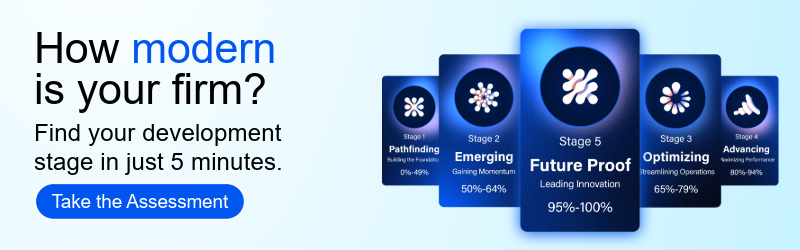
The real challenge isn’t recognizing that change is necessary—it’s understanding where your firm stands today and which areas to prioritize.
You can do that with our free Modern Firm Assessment. You’ll be able to pinpoint your strengths and opportunities across tech, security, and management in just five minutes—plus see how your practice compares to nearly 500 firms nationwide.
FAQ
The shortage stems from several converging trends: declining accounting program enrollment, an aging workforce approaching retirement, fewer candidates sitting for the CPA exam, and growing demand for accounting services that’s outpacing the available talent pool.
Turnover carries both direct and indirect costs, including recruiting, onboarding, and lost productivity while a new hire ramps up.
The strongest strategies combine a clear business model, a positive culture, flexible benefits, and a deliberate approach to onboarding and career development, rather than relying on any single tactic alone.
Culture change is a long-term process. It requires consistent effort over months and years, not a single initiative, and works best when leadership treats it as an ongoing priority rather than a one-time project.