From Reactive to Reliable: The 4 Phases of a Bookkeeping Firm Tech Stack
Key Takeaways
- Your bookkeeping firm moves through four growth phases: survival, stabilization, scale, and sustainability.
- Each phase places different demands on your tech stack; tools that fit one phase can hold you back in the next.
- Diagnosing your firm’s phase first makes every technology decision clearer and easier to defend.
- Match your tools to the phase you’re in now, not the phase you’ve already outgrown.
Most bookkeeping firm owners have lived some version of this story:
You built something real.
You landed clients, delivered the work, and figured it out as you went.
The tools you chose along the way weren’t perfect, but they got the job done.
For a while, that was enough.
Then, gradually or all at once, the systems that helped you survive start to work against you.
Manual workarounds eat up your afternoons. Disconnected tools create gaps you fill with your own time. The tech stack you’ve accumulated doesn’t quite match the firm you’re trying to build.
These growing pains signal something specific: your firm has moved into its growth era, and your technology hasn’t caught up yet.
Understanding where your business stands is the first step toward making technology decisions that serve where you’re headed, not where you’ve been.
The following framework will help you identify which phase your firm is in, and what your tech stack may look like at each one:
Phase 1. Survival: Just Get the Work Done
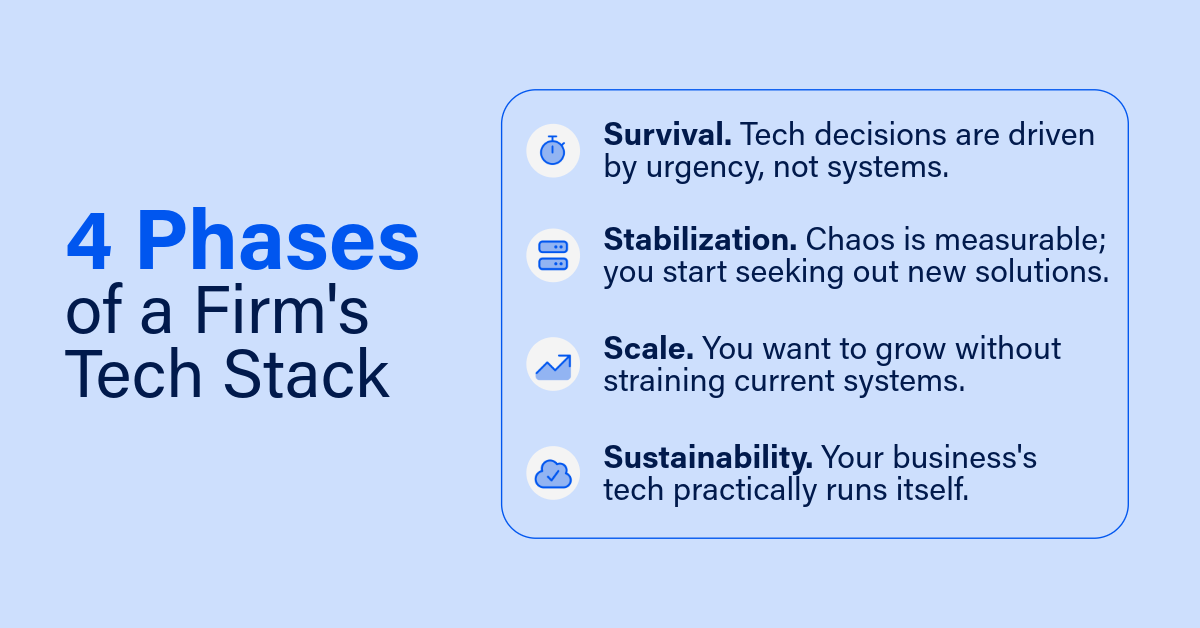
You’re likely in a phase of survival if most of your decisions are driven by urgency rather than systems.
In survival mode, the goal is simple: get the work done. Seasonality hits hard, things are messy, and consistency feels like a luxury you can’t afford yet. You’re focused on output, tolerating a certain level of chaos because you have to, and making tech decisions based on whatever gets you through the week.
That’s not a criticism. Every firm starts here. But survival-season habits, like duct-taped workflows, ad hoc tools, and pricing that doesn’t reflect the actual complexity of the work, create problems that compound quickly if left unaddressed.
Where your tech stands
- Chosen for speed and accessibility, not integration.
- Accounting tools are solid; everything else is informal.
- Communication, document sharing, and task tracking are consumer-grade.
- Redundant tools cover overlapping functions.
- Built from individual decisions, not a coherent system.
- Functional for now, but not built to scale.
During this phase, your tech should prioritize reliability and speed, not completeness.
Phase 2. Stabilization: When the Chaos Becomes Measurable
You’re in stabilization when the chaos becomes measurable and frustrating enough to fix.
At some point, the inconsistency stops being tolerable and starts being painful. You’re losing time to tasks that have nothing to do with client outcomes: syncing data, managing passwords, and chasing down documents. Your pricing feels arbitrary, and you’re not sure you’re actually making money on certain clients.
Your stabilization phase is when you start looking for real solutions. You want a more consistent model. You’re ready to stop improvising and start building.
Where your tech stands
- In audit mode, tracking down where the invisible labor lives.
- Friction points are visible: manual syncing, fragmented communication, and ad hoc access management.
- Focus has shifted to tools that reduce that friction.
- Client portal, document management, and workflow tools are becoming priorities.
- Building a more intentional stack rather than chasing a perfect one.
Here, your tech should reduce variability and surface hidden inefficiencies.

Phase 3. Scale: Growth Without the Strain
You’ve entered scale when growth is possible, but your current systems can’t support it without strain.
You’ve got some structure in place, and growth is on the table. But scaling without the right foundation is one of the fastest ways to burn out your team. In this phase, you need repeatable processes, aligned technology, and a pricing model that holds up as volume increases.
This is also when you have to get intentional about which clients you take on. The firms that scale well aren’t saying yes to everyone. They define how they work and find clients who fit that model, rather than the other way around.
Where your tech stands
- Integration is the priority, so tools work together rather than simply working.
- Workflow tools, accounting apps, communication platforms, and pricing are connected.
- The firm is moving toward a true software-as-a-service (SaaS) stack.
- Client onboarding is standardized, and communication channels are defined.
- Identity and access management is built for a growing team.
- Security protocols support offshore and remote staff.
- Capacity data is informing pricing decisions.
- Tech choices are made for repeatability, not just functionality.
Now, your tech must connect systems and support repeatability.
As your team grows across offshore and remote staff, identity and access management becomes a security priority, not an afterthought.
Phase 4. Sustainability: Systems Over Intervention
You’re in sustainability when the business runs on systems, not constant intervention.
This is what you’re building toward: a firm that doesn’t depend entirely on you, where the systems carry the load and your energy can go toward the work and the relationships that matter most. During your sustainability phase, you’re not thinking about your tech stack every day. It runs in the background, and it works.
Where your tech stands
- Streamlined, secure, and running in the background.
- No longer adding tools, but refining and optimizing what’s already there.
- Access and identity are controlled from one central platform.
- Workflows run predictably, and client communication is consistent.
- Backup and continuity systems are established and reliable.
- Technology works for the team, not the other way around.
- Operational overhead is low, leaving energy for clients and strategy.
At this point, your tech should simplify, consolidate, and run without constant oversight.
Why Your Firm’s Phase Should Drive Your Tech Stack Decisions
Once you understand your phase, your tech decisions become clearer and more constrained (in a good way.)
The technology decisions you made when you started your firm made sense at the time. But tools that helped you survive may now be slowing down your ability to stabilize, scale, or sustain.
A productive team with the right tools serves clients better. That’s an operational reality, not a soft claim. When your staff spends time on invisible labor, like admin work, access management, and manual syncing, that time comes directly out of client-facing work and your own capacity to lead.
Instead of asking which tool is best, ask what you currently require from your technology:
- In survival, you need reliability over sophistication.
- In stabilization, you need consistency: tools that reduce variability and manual effort.
- In scale, you need integration: a stack where your workflow, pricing, and client management all talk to each other.
- In sustainability, you need simplicity: a secure, streamlined setup that runs without constant oversight.
If you’re not sure whether your current stack matches your needs, a structured assessment can show you the gaps before they cost you.
The Bigger Picture: Designing the Firm You Want
Sustainability isn’t something that happens to your firm. You design it, intentionally, with the right talent, the right services, and yes, the right technology.
Growth without structure is a liability. The firms that thrive long-term build systems to support their staff, so their staff can focus on supporting clients.
Most firms don’t struggle from a lack of tools; they struggle with tools that no longer match how they operate.
So, which technology phase are you in? And is your current tech stack built for where you are—or where you were?